






Showing posts with label Authors and Illustrators. Show all posts
Showing posts with label Authors and Illustrators. Show all posts

Madonna and Child
From the cover of Life magazine, December 25, 1944 - this was the only color cover of Life during World War II.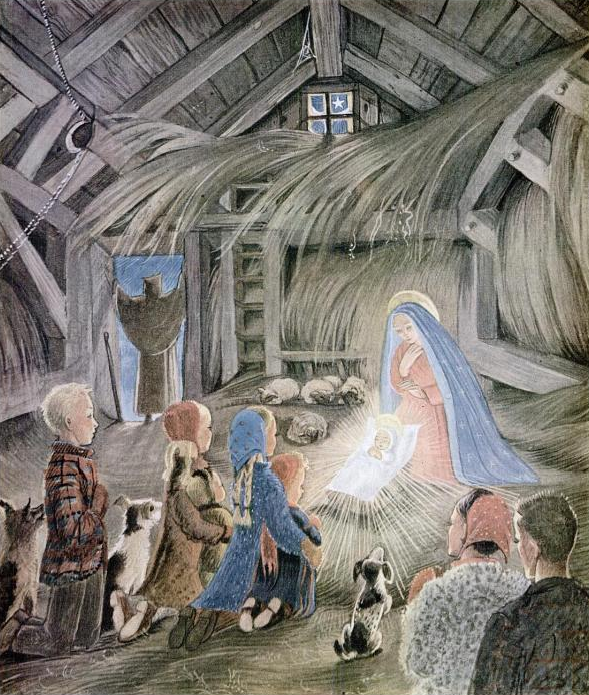
Adoration
Lauren Ford transplants the scene of the Nativity to a barn in Connecticut much like her own. Here she portrays her neighbors gazing in wonder at the Christ Child whose mother had "wrapped Him in swaddling clothes and laid Him in a manger; because there was no room for them in the inn," In the doorway stands St. Joseph awaiting the coming of the the Three Wise Men who are following the star of Bethlehem to where the Christ Child lies.
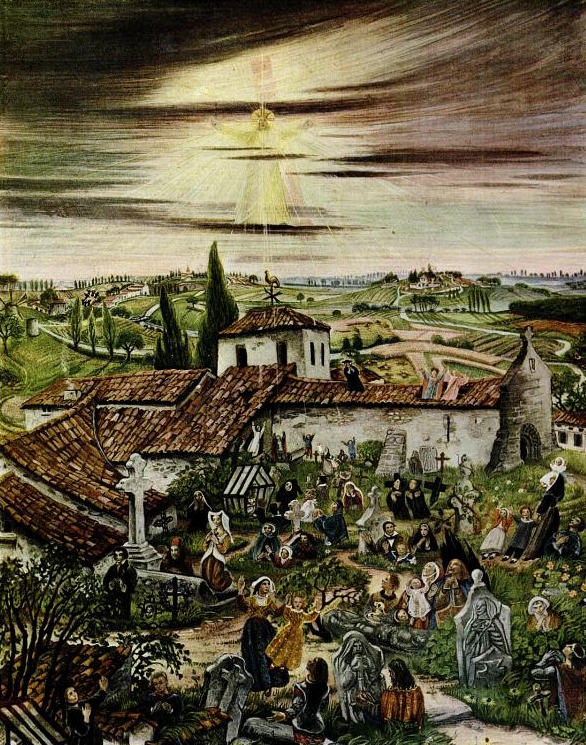
Resurrection
The day of the Last Judgement when "the dead, small and great" will stand before God is portrayed by Lauren Ford as taking place in the little churchyard of Montguyon in southwestern France. The graves open up and all hwo have been buried there emerge to be judged by Christ in the name of God. On horizon (left) is an old convent building, bought by Miss Ford and a friend and later turned into a refuge for children when Germans invaded France.
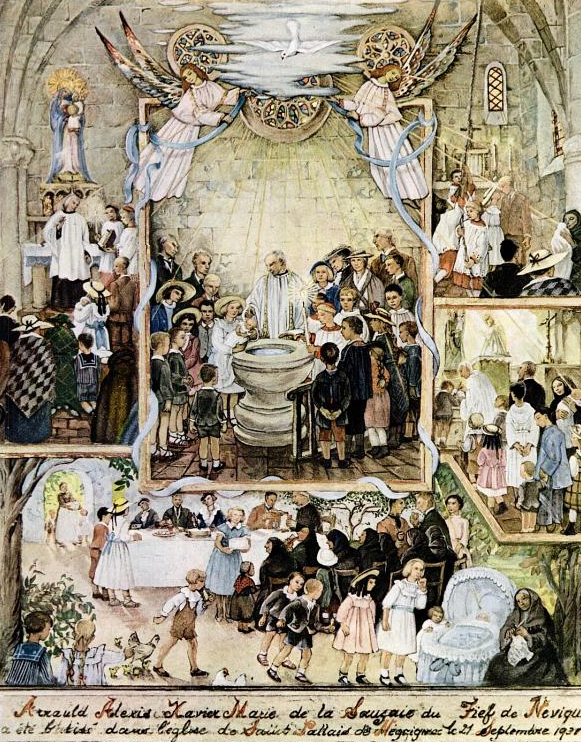
Baptism of Arnauld
While Lauren Ford was living in France, she painted as a momento the story of the baptismal rites of the child of the friends with whom she was staying. In the tradition of religious paintings of the Middle Ages, guardian angels and the dove representing the Holy Spirit hover over the baptismal scene. The baptism took place in the country church of St. Pallais de Negrignac, which Miss Ford has placed on the right horizon in the painting on the opposite page.
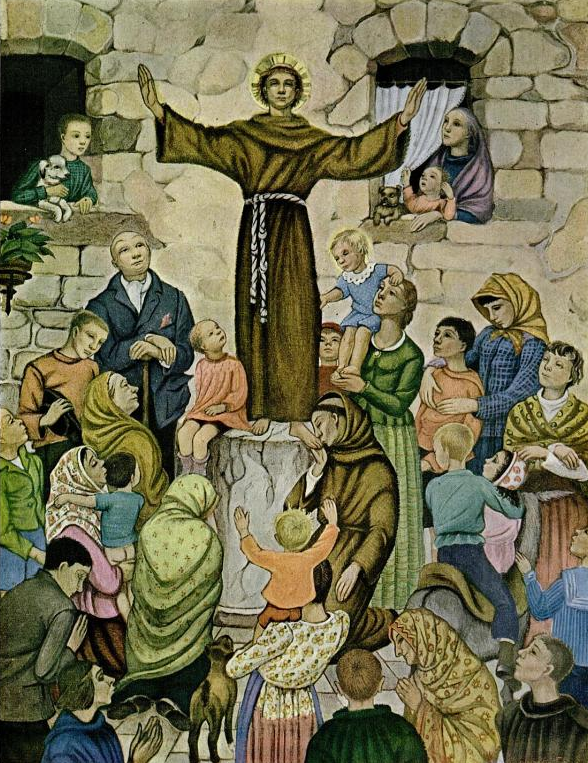
St. Francis
To paint this picture of Christ's devout disciple, Lauren Ford journeyed from France to the hilltown of Assisi in central Italy, the birthplace of St. Francis. There, on one of the little town's narrow cobblestone streets, against the background of ancient Italian architecture, Lauren Ford painted an imaginary scene symbolizing the founding of the Third Order of St. Francis, whose lay followers dedicated themselves to the teachings of humility.
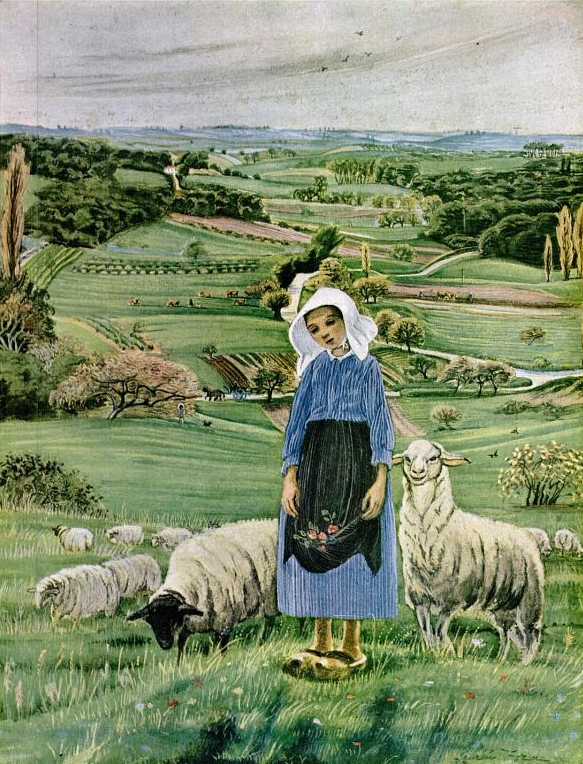
St. Germaine
St. Germaine was the child of a poor farm laborer in southern France who, after her death in 1601, was canonized. Lauren Ford shows her as a shepherdess and tells the story of the day she was accused by neighbors, whose shadows are east in foreground, of stealing food for a starving stranger. At the demand that she show what she has hidden in her apron, Germaine miraculously revealed fresh roses though it was late autumn and roses were not in bloom.
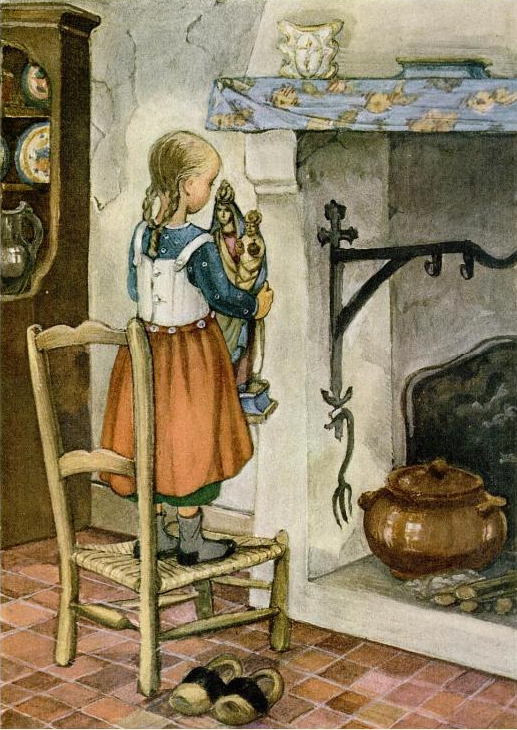
The Celestial Mother
A scene in the childhood of Blessed Catherine Laboure was painted by Lauren Ford. Left motherless, Catherine climbed up on chair and, lifting the statue of the Virgin from the mantel, asked that the Virgin be her adopted mother. Later, as a nun, Catherine predicted France would go through a terrible stress. She died in 1876, leaving a diary which told of miraculous visions, and was beatified in 1933.
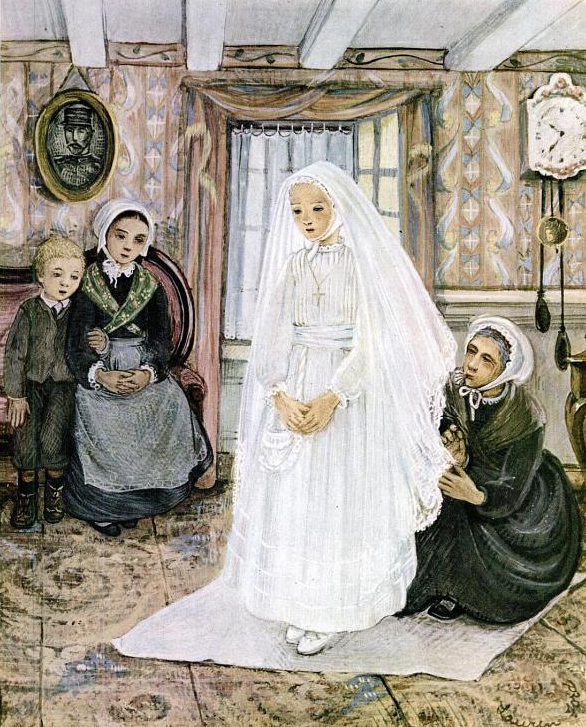
The First Communion Dress
Catherine Laboure is being dressed for her First Communion in the home of her godmother, who is shown with her mouth full of pins, adjusting Catherine's long veil. Watching them in awed silence are Catherine's sister Tonine and brother Auguste. To protect the pristine whitness of the precious dress, which has been handed down from generation to generation, Catherine stands upon a spotless carpet specially spread for this momentous occasion.
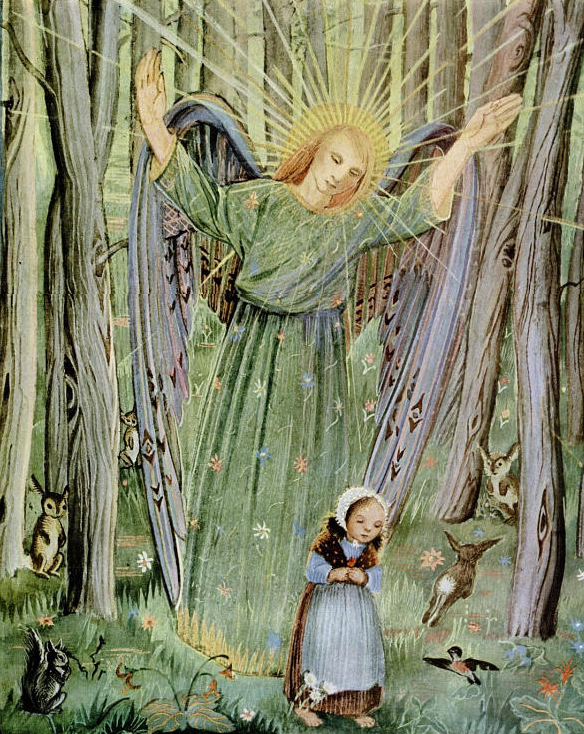
Guardian Angel
The child trudging through the woods protected only by her guardian angel is Melanie de La Salette, who lived 100 years ago in southeastern France. The fifth child of poor peasants, Melanie had an unnaturally brutal mother who sent her out to beg and often tried to lose her in the woods. But Melanie, watched over by her guardian angel, miraculously survived and later, when Melanie's mother grew old, the girl cared for her tenderly until her death.
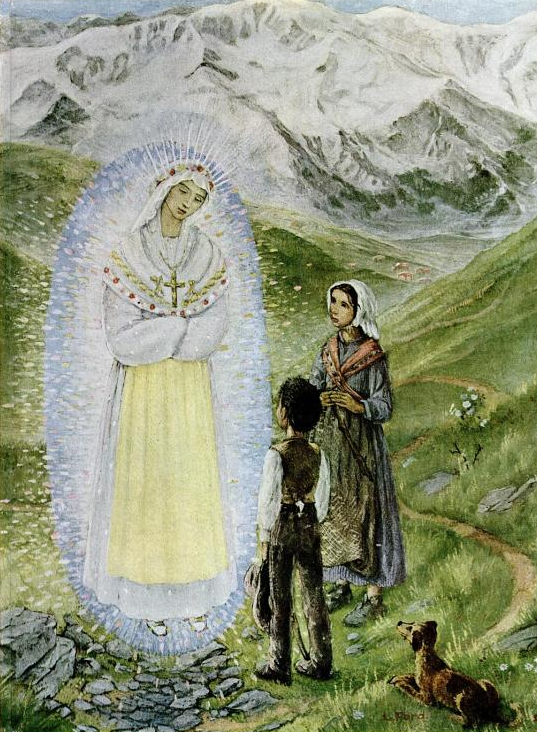
Vision of La Salette
When Melanie de La Salette was 14 the vision of the Virgin appeared to her and her little friend Maxim while they were wandering about in the fields. The Virgin stood before them wearing an apron "the color of light, her gown sewn with pearls that looked like tears." She spoke in perfect French which the children were able to repeat to their elders, though they ordinarily could speak only the dialect of the countryside.
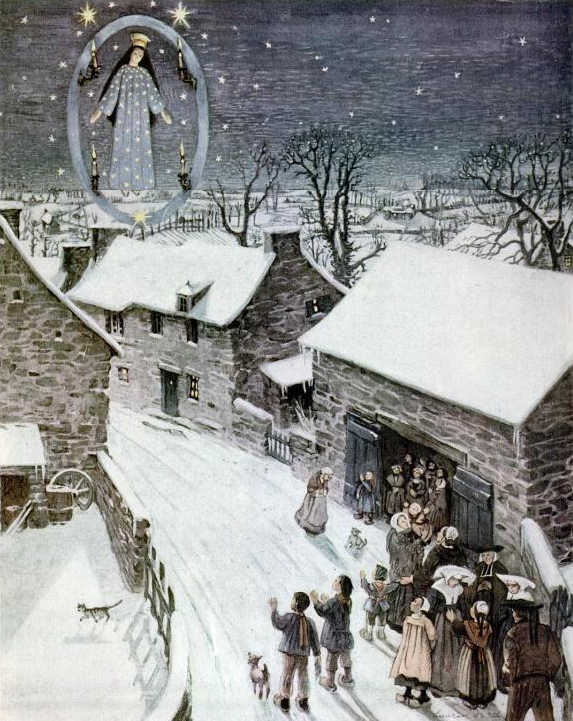
The Vision at Dusk
One evening in 1871 the villagers of Pontmain in Brittany were praying that they be saved from Prussian invaders who were one mile from the town. Suddenly six small children playing in the snow saw in the sky the Virgin appear surrounded by a halo of light. Attracted by the children's exclamations, the older people came running. Since they were grownups, they could see nothing. But within a half hour the Prussians were turned back.
From "A Portfolio of Religious Paintings by Lauren Ford," Life magazine, Dec 25, 1944.
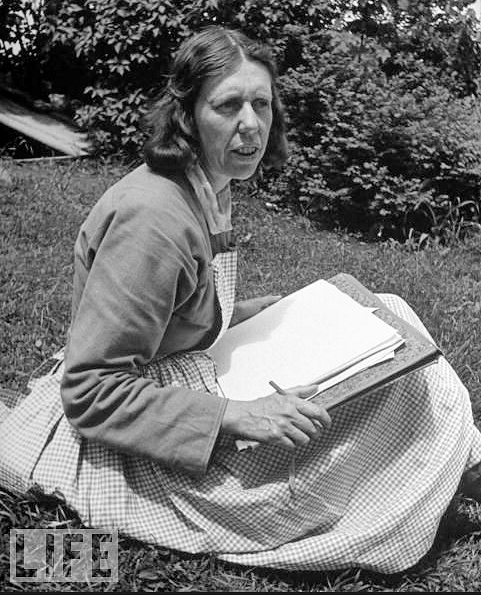
As fellow author Nina Wilcox Putnam described her, "Mrs. Ford collected celebrities as some people collect postage stamps." She was hostess of a twice weekly salon at her New York town house that included notables such as Kahlil Gibran, Ezra Pound, Isadora Duncan, Bertrand Russell, Charlie Chaplin, William Butler Yeats, and Anna May Wong.
"Mrs. Ford had a great interest in the Pre-Raphaelite painters and later artists such as JW Waterhouse and Arthur Hacker, both of whom she knew personally. She went to Germany to meet the German painter Franz von Stuck and to get photographic reproductions of his work. She created her own wallpaper for her upstairs study by arranging on the walls as a mosaic over two hundred photographic reproductions of pictures by these artists." (Source: The Yale University Library Gazette, 1926, via JW Waterhouse)

The Fords married on May 29, 1883 and subsequently bore three children: Ellsworth, born in 1885, Julia Lauren, born in 1890, and Hobart born, in 1894.
Because Lauren's mother wanted her to become an artist and had very definite ideas about education, she was taught to draw when she was only 18 months old. "You have to do things for children when they are very young," she said. At the age of 9, Lauren was sent to Brittany to study painting with her uncle and namesake, Lawrence Shaw, a portrait painter. His instruction, France's medieval art, and the beauty of the liturgy and Gregorian chants of the monks of Solesmes nourished her creative and spiritual growth. She subsequently went on to study at Academie Colarossi in Paris, where she was introduced to the European academic tradition. Later she studied with Frank V. Dumond and George Bridgman at Art Students League in New York. The revival of ecclesiastical art had the greatest influence in her work. Major figures in the movement included her friends Marie Fauconnier, Frances Delehanty, and Justine Ward.


After World War II, she was instrumental in the founding of the Abbey of Regina Laudis in Bethlehem, CT (there's a lovely photographic study of the Abbey here). The story of her role in the founding of the Abbey was the basis for the 1949 film starring Loretta Young, "Come to the Stable," and is also discussed in the book, Mother Benedict by Antoinette Bosco. In 1973, Lauren passed away at the age of 82, leaving her estate to the Abbey.
- The Little Book About God (1934)
- Claude: A Tale of an-Idyllic Childhood by Genevieve Fauconnier, Translated and Illustrated by Lauren Ford (1937)
- The Agless Story: With Its Antiphons (1939; beautifully written about here, illustrations shown here)
- Our Lady's Book (1961)
- Lauren Ford's Christmas Book (1963)
- Imagina by Julia Ellsworth Ford, Illustrated by Arthur Rackham and Lauren Ford (1914)
- Memoirs of a Donkey by Madame de Segur (1924)
- Bells of Heaven, The Story of Joan of Arc by Christopher Bick (1949)
- Treasure on the Hill by Marie Lyons Killilea (1960)
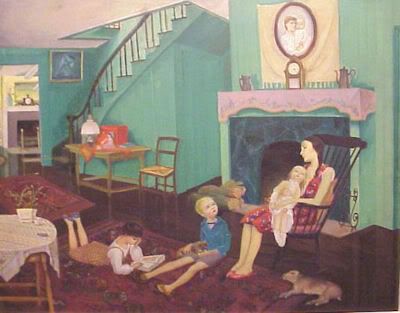
La Grippe (Home Fires)
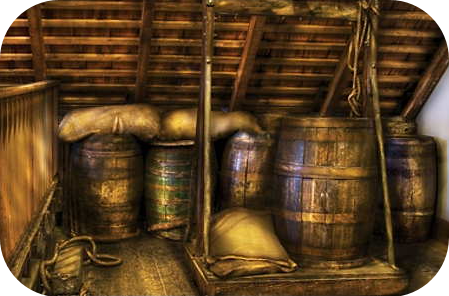
Our garden was SUCH a flop this year, for the first time ever, so needless to say, I can only dream of having a pantry such as the one described below (from The Country Kitchen by Della T. Lutes). It makes me long for those "simpler" times and is an inspiration to do more (and better!) next year.
"Autumn is here. The blue of October sky grows thick, is filmed with grey. The apples are picked and barrelled, to put in bins. Baldwins, selected for long keeping, Northern Spies, Greenings, Jonathans, Seek-No-Furthers, Russets, Gillyflowers, in the bins for more immediate use, or, if the cellar is unsafe in coldest weather, in the apple pit outside. Lovely names, incomparable fruit. Cider and vinegar barrels are full. ---
Cellar and pantry are stocked. There is a barrel of wheat flour in the latter, at least a twenty-five-pound sack of white sugar, with as much of brown, and a sack of buckwheat flour, with another of corn meal. When these are used up we shall go to the mill. There is molasses in a big jug, and coffee, tea, and other groceries on the shelves. And the bean barrel - we must not forget the bean barrel, for it plays no inconsiderable part in the winter diet.
In the cellar, besides the bins of apples and potatoes, the piles of squash, turnips, and cabbage lying on the uncovered ground, there are cupboards and shelves full of canned and preserved fruits. Perhaps a pan of broken honeycomb, for my father always kept a few hives of bees.
My mother (as did all her contemporaries) began this preparation for winter with the strawberry crop. When the best and heaviest pickings were over - those that brought the best price - the preserving began, until there were dozens of glasses standing in back in a dark corner in order that the delicate colour might not fade.
Following the strawberries came raspberries - 'rawsberries,' we called them - black caps, and red, also transmuted into jam to be eaten on freshly baked bread for supper or used in tarts; gooseberries for a 'fool' or to be served with game; currants - many, many glasses of jelly, for this makes the best jelly roll, and is the best accompaniment to the chickens, turkey, or game dinner.
Jars of cherries, plums, pears, peaches, and small stone crocks opulen and fragrant with preserves: citron, quince, gingered pears.
And pickles! No end of pickles. First of all there was a barrel of cucumbers preserved in brine. These would be taken out as needed, freshed in cold water, and then soured in spiced vinegar. There were crocks of sweet pickles, mustard pickles, chowchow, piccalilli, watermelon rind. Bottles of catsup - chili sauce. ---
In the attic were bags of nuts, strings of peppers, and bunches of herbs - sage and savoury, as well as those of medicinal nature. And dried apples in some! Ah how pungent was the air, how teasing at every turn was the odour of this provident brewing during all the days of summer and fall. How infinitely satisfactory to the housewifely eye was this cumulative show of conserved surplus, this prescient gratification of anticipated need, this lavish prospicience to individual and family appetite.
Not the cleverness of a well-turned verse, nor the glut of colour in a glowing canvas, can more fully slake the thirst of creeation that does this rich provision for her family's needs satisfy the true home lover. And as a remedy for boredom, ennui, or a flagging spirit, I can recommend nothing more salutary than a garden for production and a cellar for preservation of its harvest."
It was this blog post that first introduced me to Della Thompson Lutes (and Ruth Suckow, whom I'll be reading next), and for that, I am eternally grateful. I've just finished reading Millbrook, one of her six autobiographical novels, and it was truly a delight! The book is set in a small Southern Michigan farming community in the 1880s; here is a sample that seemed especially timely now, at the very height of summer:
Summer was far too busy a season to allow for much visiting, speculation, or gossip. Women were in their kitchens. Bread to bake as well as cakes, cookies, and pies; vegetables to prepare; milk to care for; butter to churn.
They were in the gardens: fruit to pick for shortcakes, pies, tarts, preserves. They were in their poulty yards: young chickens, turkeys, ducks, geese to be fed, watered, housed, gathered in from storms; eggs to be brought in.
They washed: shoulder-sweated shirts and stiff, groin-sweated overalls; sheets yellowed by soil-stained, perspiring bodies. And in a wooden tub on a bench too low for comfort, scrubbing their knuckles on a corrugated board of zinc, using soft soap they themselves had made.
They ironed, sensibly, only the clothing that showed, and linen for the tables. Where there were girls and young women, of course, there were innumerable ruffles -- petticoats, corset covers, lawn and organdie dresses. The irons were solid and heavy (used in winter, tipped up sideways between the knees, for cracking nuts, and also heated for warming beds) and, even through the padded holder, seared and callused the hands.
They worked: Adelaide from the first paling of a morning sky until the bats flew at dusk and the night hawk dipped, cleaving the air with a downward noisy swish of his stiffly outspread wings; but her heart was light. (Millbrook, p. 258-9)

I'm waiting on a copy of the author's famed Country Kitchen, and will be eagerly tracking down copies of her other books as well. While all are currently out-of-print, copies can be found quite inexpensively online. Hopefully one day her work will again be back in print because it is truly worthy of a wider reading audience.
Though there is sadly little that has been published about her life, a wonderful introductory essay is: A Word For What Was Eaten: An Introduction to Della T. Lutes and Her Fiction by Lawrence R. Dawson. The following biography is an excerpt, also written by Mr. Dawson, from the Dictionary of Midwestern Literature: Volume 1: The Authors by Phillip A. Greasley, Society for the Study of Midwestern Literature.

She said that her first writing for money appeared in the Detroit Free Press. In October 1905, the Delineator began her six-part story, "Deestrick No. 5." Her first book, Just Away: A Story of Hope (1906) was promoted by the death of her son, Ralph, and dedicated "To the mothers who sorrowed with me in my sorrow." Impressed by this work, the publishers invited her in 1907 to Cooperstown, New York, to join the editorial staff of their journals American Motherhood, Table Talk, and Today's Housewife. In 1924 she became housekeeping editor of Modern Priscilla and manager of the Priscilla Proving Plant (a Betty Crocker-type institute).in Newton, Massachusetts.
Her writing was directed by her editorial responsibilities under the Priscilla organization disbanded after the 1929 stock market crash, her articles, pamphlets and books being mainly concerned with home-making topics. Still, her stylistic qualities of common sense and often pungent wit grew during these years.
The appearance of her essay "Simple Epicure" in the Atlantic of March 1935 began her success with a larger public. This essay and others which quickly followed provoked an unusually broad reaction from the magazine's readers, a great many of whom were men. These essays were collected and published in 1936 as The Country Kitchen; the book established her as a best-selling, sought-after writer and speaker. During her last years, her surviving sone, Robert, became her leg man, researching her last books. She died on July 13, 1942, at Cooperstown, New York. Her ashes were returned, as she wished, to Michigan for interment at Horton.
Significance: Della Lute's writing is significant for its rendering of the end-of-the-century cultural period, as her readers recognized when her articles and books appeared during the 1930s and 1940s. Appealing to natives of rural Michigan and the Midwest, her books brought letters of praise from every part of the nation and from other countries, including Russia. Detailing the landscapes through the changing seasons, her stories also brought alive local politics, schooling, architecture and interior decoration, moral standards, social attitudes, and, in a unique way, the food as "prepared by late nineteenth century southern Michigan farm wives" ("A Word..." 31). Her readers commended her writing particularly for its affectionate, realistic, and accurate recording of rural family life as it was lived in America at the end of the nineteenth century.
Select Books by Della Thompson Lutes:
- The Country Kitchen (1936)
- Homegrown (1937)
- Millbrook (1938)
- Gabriel's Search (1940)
- Country Schoolma'am (1941)
- Cousin William (1942)

This morning was spent attempting to search out information on Corinne Malvern, an illustrator whom I loved as a child and was just recently re-introduced to. Though she was an incredibly prolific and talented artist, there is sadly little known about her life.
Corinne Malvern was born in Newark, New Jersey in 1905/6 (dates vary). Her mother was Cora L. Malvern of Virgina, born in 1868, and a widow by 1920. Nothing is known about her father.
From a very early age, Corinne and her elder sister Gladys became regulars on the vaudeville circuit and were well-known child actors. In 1908, Corinne appeared on stage in, among other things, "The Man Who Stood Still" at the Circle Theater on Broadway in New York. A New York Times article from the same year praised her "natural, unaffected acting" and notes that, though the plays presented were "grewsome and in parts revolting" she "completely captivated the audience."

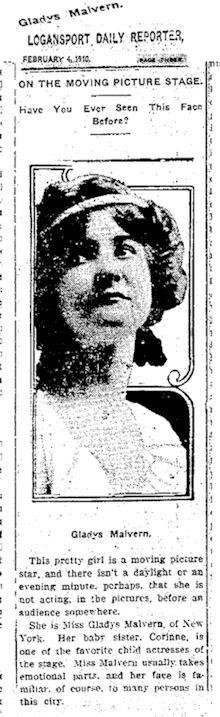
By 1910, both Corinne and Gladys were moonlighting in motion pictures as well, and profiled in the series of newspaper articles, "On the Moving Picture Stage: Have You Seen this Face?" More details can be found here. The only film that Corinne actually received credit for appearing in is "The Luring Lights" in 1915. In a later interview, Gladys would state that, "[growing up] home to me was anywhere - hotels, trains, boarding houses; for my sister and I were 'stage children.'"
A railroad accident put an end to Corinne's acting career and left her crippled for two years. In the 1920's she attended the Art Students League in New York and then moved to Los Angeles with her mother and sister, studying with Theodore Lukits. The 1930 census indicates that, at that time, she was employed as a fashion artist for a millinery studio, while her sister Gladys was a Sales Manager at a department store. Corinne continued her art education in Los Angeles by taking night classes, and occasionally selling her paintings to earn extra money.
 By at least 1937, Corinne was back in New York where she shared a studio apartment with her sister and worked as a [freelance?] art editor for Ladies' Home Journal (one of her covers is shown on the left), contributing work to other publications as well. In 1939, her first book, co-written with Gladys, was published by McLaughlin. The book was entitled Brownie, The Little Bear Who Liked People. In 1942, she illustrated one of the very first Little Golden Books, Nursery Songs.
During the 1940's, Corinne worked as an illustrator for Ginn Readers, in particular, their Faith and Freedom series, while also continuing to illustrate books for both McLaughlin and Random House. This she continued throughout the 1940's - 50's, and when her sister began publishing novels, she illustrated those as well. Frosty the Snow Man (1951), Twas the Night Before Christmas (1949), Doctor Dan the Bandage Man (1951) and Nurse Nancy (1958) were among her most popular Golden Books; only these last two have been re-printed in recent years. (Am I the only one who would love to see a Corinne Malvern anthology?! Surely not!)
A 1953 biography notes that "she divides her time between New York and Connecticut, where she indulges in her favorite hobby of gardening." Corinne Malvern passed away at a Weston, Connecticut convalescent home at the age of 50, on November 9, 1956. She was survived by her sister Gladys.
A railroad accident put an end to Corinne's acting career and left her crippled for two years. In the 1920's she attended the Art Students League in New York and then moved to Los Angeles with her mother and sister, studying with Theodore Lukits. The 1930 census indicates that, at that time, she was employed as a fashion artist for a millinery studio, while her sister Gladys was a Sales Manager at a department store. Corinne continued her art education in Los Angeles by taking night classes, and occasionally selling her paintings to earn extra money.
 By at least 1937, Corinne was back in New York where she shared a studio apartment with her sister and worked as a [freelance?] art editor for Ladies' Home Journal (one of her covers is shown on the left), contributing work to other publications as well. In 1939, her first book, co-written with Gladys, was published by McLaughlin. The book was entitled Brownie, The Little Bear Who Liked People. In 1942, she illustrated one of the very first Little Golden Books, Nursery Songs.
During the 1940's, Corinne worked as an illustrator for Ginn Readers, in particular, their Faith and Freedom series, while also continuing to illustrate books for both McLaughlin and Random House. This she continued throughout the 1940's - 50's, and when her sister began publishing novels, she illustrated those as well. Frosty the Snow Man (1951), Twas the Night Before Christmas (1949), Doctor Dan the Bandage Man (1951) and Nurse Nancy (1958) were among her most popular Golden Books; only these last two have been re-printed in recent years. (Am I the only one who would love to see a Corinne Malvern anthology?! Surely not!)
A 1953 biography notes that "she divides her time between New York and Connecticut, where she indulges in her favorite hobby of gardening." Corinne Malvern passed away at a Weston, Connecticut convalescent home at the age of 50, on November 9, 1956. She was survived by her sister Gladys.

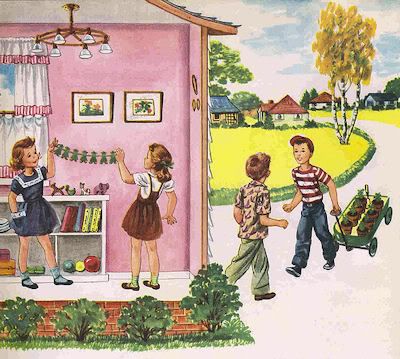



Susie's New Stove, The Little Chef's Cookbook, 1950

Subscribe to:
Posts (Atom)