






© Adocel
On this day, December 12th, people from all parts of Mexico make their way to Mexico's chief religious center at the Basilica of the Virgen of Guadalupe, located in Villa de Guadalupe Hidalgo, a northern neighbourhood of Mexico City. There, they will celebrate the Nuestra Senora de Guadalupe (Our Lady of Guadalupe) with a mass ceremony and a traditional fair in her honor.
The Dia de la Virgen de Guadalupe became an national holiday in 1859. At the plaza the fiesta starts after the mass ceremony with delicious food, vendors selling crafts and clothes, along with many performences of music and dance. In other parts of Mexico, similar festivities are organized with some unique variations of the celebration. In some places, altars of flowers are built in her honor. Other parts have traditional food prepared like buñuelos, raspados and tortas as well as activities like parades, rodeos, and bullfights. (Source)
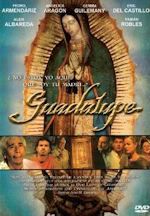
Books/DVD
- The Lady of Guadalupe by Tomie dePaola (Ages 9-12; 48 pgs)
- Saint Juan Diego and Our Lady of Guadalupe by Josephine Nobisso (Ages 9-12; 120 pgs)
- A Handbook on Guadalupe by Sister Mary Francis
- The Wonder of Guadalupe: The Origin and Cult of the Miraculous Image of the Blessed Virgin in Mexico by Francis Johnston

Religious Goods
- MexGrocer.com has a variety of Guadalupe items
- Our Lady of Guadalupe at Etsy
- Guadalupe Papel Picado Banner
- See Also: eBay
- Our Lady of Guadalupe at Sancta.org
- Proyecto Guadalupe (in Spanish, requires Google Translate)
- Our Lady of Guadalupe Feast Day Plans at O Night Divine - very comprehensive!
- Our Lady of Guadalupe at Domestic-Church.com


© ektarama
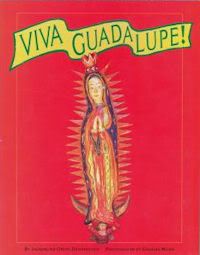
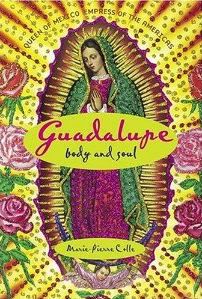
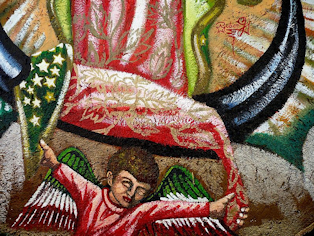
CraftsTomie dePaola has a great story on his website about Our Lady of Guadalupe as the Patron of Artists and I could not agree more! Without a doubt, she has been inspiring artists (Catholic or not) for the past 500 years. To explore Our Lady of Guadalupe in art:
Articles:
- Chasing Virgins
- Virgin With a Rebel Vibe
- The Virgin Had This Homeboy's Back
- Virgin as Muse
- Virgin as Spin-Mistress
- Icons of the Virgin (in Spanish)


© Jani-que
Art/Craft Projects:
- How to Draw Our Lady of Guadalupe (.PDF) from CHC
- Our Lady of Guadalupe Coloring Book by Mary Fabyan Windeatt (Coloring page here)
- Our Lady of Guadalupe and Juan Diego Coloring/Paper Dolls at Paper Dali
- Our Lady of Guadalupe Ornament at 4Real Forums
- Clay Guadalupe at Crayola
- Virgin of Guadalupe Plaster Craft Mold (9.75" H)
- Our Lady of Guadalupe Fabrics at Some Art Fabric
- Virgin of Guadalupe Sugar Mold at Mexican Sugar Skulls
- Virgen de Guadalupe at Silver Crow Creations
- Virgin of Guadalupe Hand-Carved Rubber Stamp at Etsy
- Our Lady of Guadalupe Stamp at Catholic Rubber Stamps
- Our Lady of Guadalupe Marian Grotto Kit at Illuminated Ink
- Our Lady of Guadalupe Cut 'n Color Book at Illuminated Ink
- Sopapillas with Chile Verde Con Carne
- Bunuelos (Mexican donuts; traditional food)
- Pan Dulce (Sweet bread; traditional food)
- Our Lady of Guadalupe Recipes at Catholic Cuisine
- Cupcakes - See below (Rose Picks, Foil Baking Cups)






This week marked our second week of the new school year, and clearly, we've still got some issues to work out. Somehow, I had greatly underestimated the amount of time each subject would take now that I have only two students (and very speedy students at that!). As a result, our days have been embarrassingly brief. Granted we are waiting on our Math and Science books to arrive, but even still, the work is going way too quickly. I'm still trying to figure out what we can do differently in the future!
Religion
Each day began with a reading from Saints for Young Readers, Vol. 2, followed by lesson work from St. Joseph's Baltimore Catechism No. 2. This week, the kids were responsible for memorizing the last two catechism questions/answers from Lesson 1 (last week they memorized the first five), which included the Apostles' Creed.
- We read (p. 9 - 46) from the beautiful An Illustrated Catechism by Inos Biffi to learn the meaning behind each line of the Apostles' Creed and completed a fill-in-the-blank worksheet on the Creed from 100 Activities Based on the Catechism of the Catholic Church.
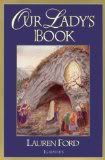
- Each morning I read a little from the gem Our Lady's Book by artist/storyteller Lauren Ford. The book tells the story, in words and pictures, of the apparitions of Our Lady at LaSalette, Fatima, Pomain, Lourdes, and Rue de Bac.
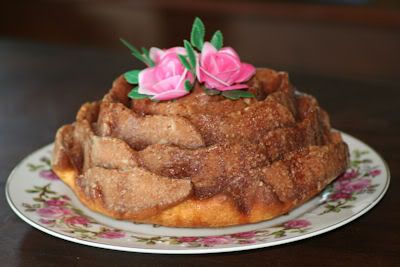
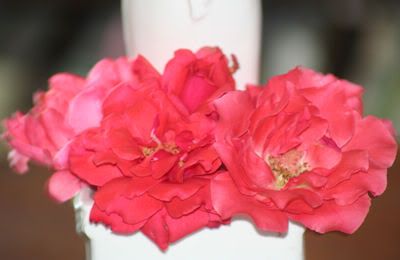
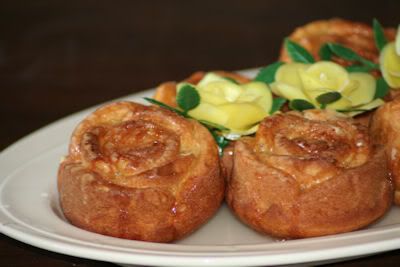
- For the Feast of St. Rose of Lima, we had rose-shaped, rose-secented cup cakes and a small rose cake (with the leftover batter) and colored this picture from CHC.
- For the Feast of St. Louis IX, King of France, we read the story Saint and King from Saints and Heroes by Mrs. Lang. We also attempted to make some St. Louis Gooey Butter Cake, which really has nothing to do with the saint (except in name), but is a traditional dessert from St. Louis the city. Unfortunately, the batter didn't rise, so it was a complete loss.
Language Arts
Language arts seems to comprise our central focus this year, though this wasn't intentional. It's also a bit of a mess at the moment (what's new?!). I realized mid-week that my choice for composition wasn't the greatest (it was the first composition book that I'd found on Google Books and is probably too advanced), so I am planning on finding a suitable replacement this weekend.
I love the supplement for teachers, Methods and Material for Composition by Alhambra G. Denning and would like to utilize this somehow, maybe. I wanted something in the style of Primary Language Lessons, but better - I think Vital English (Intermediate text here) may be the solution, but will be exploring this further.
- Handwriting: Two worksheets per day (M-Th).
- Spelling: One lesson per day from Word Power Through Spelling. We love these books, but the words have proven a bit too easy. I may need to bump them up a level or two because they're not being adequately challenged.
- Vocabulary: One lesson per day (M-Th) from Vocabulary 5 for Young Catholics.
- Grammar: One lesson per day from Voyages in English (nouns). These books proved hugely disappointing. We have chosen to ignore the rather uneven lessons at the beginning of the book and instead are strictly doing the grammar exercises in Part 2.
- Composition: Three exercises from A Composition-Grammar. This week's lessons covered: the nature of a sentence, affirmative or negative thought, declarative or interrogative thought, and exclamatory or non-exclamatory thought. Also, the rules for paragraphs and quotation marks, and, oddly enough, "the study of lettering" (this issue of The School Arts Magazine from October, 1919 proved a helpful supplement.)
- Reading: Two lessons from This Is Our Heritage (6th) and These Are Our People (5th), two lessons from Reading 5/6 for Young Catholics, Comprehension Skills and one lesson each from Reading 5/6 for Young Catholics, Thinking Skills.
History is, at the moment, a bit of an experiment. Because I was very late in deciding what we would study this year, I didn't get the necessary texts and supplements figured out in time (and I was broke by the time I had a plan!), so I had to improvise.
Finally I decided that we would wrap up the Middle Ages and start on American history in January. I divided our first semester (18 weeks) into two week "units," created an outline of what needed to be covered, and set about finding resources with the help of my favorite Google Books. Our "spine" is The Story of Old Europe and Young America and proved especially helpful because, at the end of each chapter, it lists suggestions for additional reading (all easily found using Google Books). So, for each unit, I printed the applicable portion from our spine, printed the supplements, and organized everything in my history filing crate. When this was finished, I went back and printed out maps, worksheets, coloring pages, etc. for each unit and filed them in the crate also. Activity ideas were written out on 3 x 5 index cards and dropped into the appropriate files.

At the start of a new two-week unit, the reading goes into one of these 3-prong poly folders (for history, they share the folder, but for other subjects, I've provided each with his own "text"). Each morning I count out the pages to be read and flag them with these handy-dandy Clip-rite clip tabs; they know by now to read from "tab to tab" each day. Supplements go into the folder's pockets, to be completed after reading.
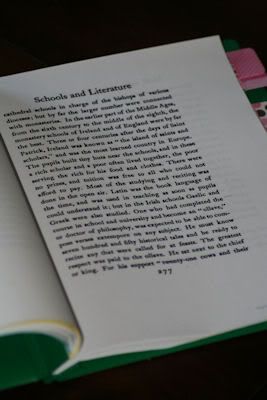
What I love about this system is that it allows me to keep the amount of daily reading fairly even, supplement with the material I choose, costs virtually nothing, and it eliminates the stacks of extra books/supplements we were always scrambling to keep track of. Plus, if I change my mind about a particular supplement (which happens often!), I can switch to something else easily and without guilt.
The first of our history units also proved the most awkwardly put together, since I was picking up from the middle of a chapter in our spine, yet somehow it worked out well enough. We studied the Vikings and also schools, music and literature in the Middle Ages. In addition to our spine, our supplements included stories from Viking Tales by Jennie Hall, European Hero Stories, England's Story, and When Knights Were Bold (my favorite!), all by Eva March Tappan. On average there was 10-15 pages of reading per day. Earlier, I had created some notebooking pages on Vikings, but we never even used them, instead opting for oral narration. We listened to plenty of Medieval music and watched Terry Jones' Medieval Lives: The Minstrel on YouTube. Our read aloud, which we started only this week, was Adam of the Road.
Science
The beautiful weather this week (finally, after a non-existent spring and a long blazing hot summer!) brought us outdoors. Prior to starting the week, I had no immediate plans in place for science. This year we'll be studying Chemistry, but I haven't ordered all of our books yet.
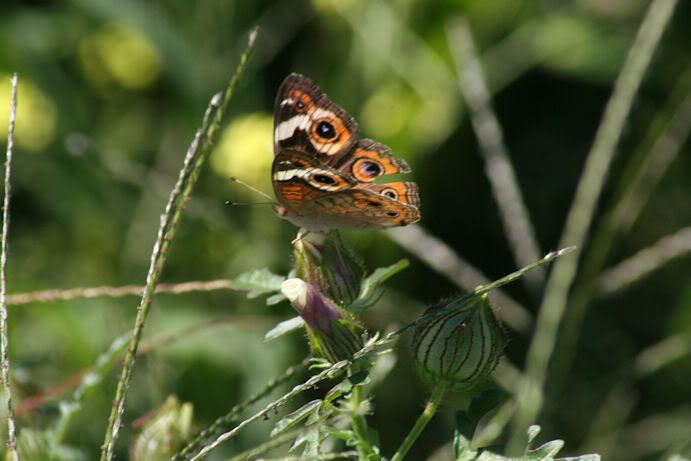
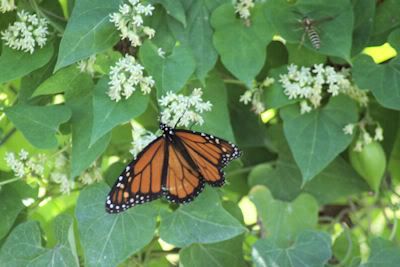
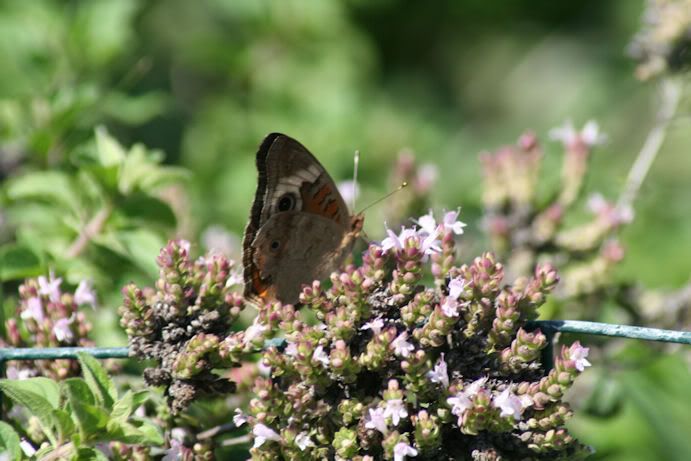
It just so happens that this year we were blessed with the appearance of a mysterious vine (weed), which quickly took over a portion of our back fence. A little research revealed that the vine was called Sand Vine Milkweed, (also, Honeyvine) a very important source of food for Monarchs. Despite warnings about the invasiveness of the vine, I decided to leave it alone since I love how sweetly it smells and don't mind it's appearance in the least. As the summer progressed, it very quickly became the most popular place in our yard for an astonishing variety of winged creatures - from every type of bee imaginable to a dizzying array of butterflies.

All abuzz! (Click on photo to enlarge)
This week has been no exception, so at the very last minute, I decided that we would do a brief nature study on butterflies and moths.
Once again, Google Books came to the rescue. I quickly put together a 47-page Nature Reader with relevant stories and information. We've been casually observing the insects all summer long, but now the plan is to have the kids spend a little time formally observing and identifying the butterflies and sketching in their nature journals, followed by some light reading. We will be continuing with this plan next week, so long as the weather holds out. Should I happen to require additional reading, The Insect Folk: Butterflies and Bees (Vol. 2) by Margaret Warner Morley appears to be excellent.
Math
As with everything else, Math was not quite all I'd hoped it would be. Foolishly, all summer long I'd assumed that we had the necessary books for the new school year (I'm certain I ordered them last year!). Since we're using Singapore and it's very, very straightforward, no pre-planning was required. When I discovered, much to my horror, that I did not have the necessary books, I had to come up with a new plan. So, for the past two weeks we've been doing daily math drill worksheets and working on memorization of the multiplication tables through 9 (this was much needed!). Hopefully our Singapore books will arrive next week!
Personal Notes
This has been a quiet week all around. I've been battling some sort of flu/virus all week, so have had zero energy, which never fails to annoy me. Hopefully I'll bounce back this weekend because we have a big busy week ahead!
This week I read A Breath of Air by Rumer Godden, which was a light, enjoyable read. That said, I think I preferred her novel In This House of Brede, which I read last week. I'm eyeing Five for Sorrow, Ten for Joy to read next. I also read Saint Clare: Beyond the Legend by Marco Bartoli (which I'll be reviewing shortly) and re-read The Moonstone by Wilkie Collins.


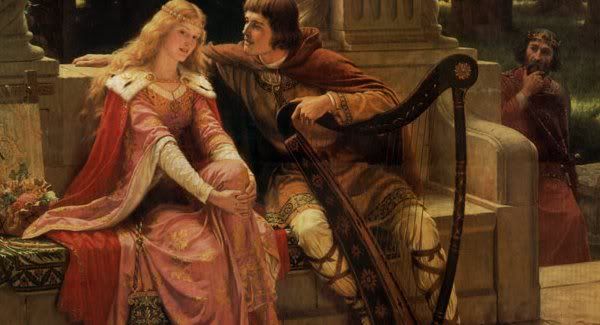
At home people organised their own entertainment, where they might sing local and traditional songs which were accompanied by improvised music. The songs varied from village to village, and related local tales and events. In the early medieval period songs were sung in a simple way (monophony), but later in the medieval period songs became more complicated with a double melody (polyphony). Travelling troubadours and minstrels brought songs and news from village to village, with their accompanying jongleurs and their musical instruments such as the recorder, the shawm and the cittern. These songs were often comic entertainment
The songs often told of love and heroism, sometimes in comedy and sometimes in all seriousness.
The Troubadours
An Overview on Troubadours from Medieval Life and Times
The troubadours were mostly aristocratic poets rather than wandering minstrels or jongleurs and flourished in Provence in southern France from the end of the eleventh to the end of the thirteenth centuries. They composed elaborate lyrics of courtly love which had an extensive influence on Western poetry and culture.
Approximately 2,600 poems and some 260 melodies have been preserved. Some important troubadours were:
The troubadours were mostly aristocratic poets rather than wandering minstrels or jongleurs and flourished in Provence in southern France from the end of the eleventh to the end of the thirteenth centuries. They composed elaborate lyrics of courtly love which had an extensive influence on Western poetry and culture.
Approximately 2,600 poems and some 260 melodies have been preserved. Some important troubadours were:
Marcabru of Gascony, c. 1100 - c.1150
- Song: L'autrier jost'una sebissa (YouTube)
Giraut de Bornelh, c. 1138 – 1215
Guiraut Riquier, c. 1230 - 1300
Bertran de Born, c. 1145 - 1215
The Trouvères
The trouvères flourished in northern France slightly later than the troubadours. Of their poems, 2,130 still exist, and 1,420 of them have been preserved with their melodies. Some important trouvères were:
Conon de Béthune, c. 1160 - 1200- Song: Bien me deüsse targier
- Song: Tant ai amé
- Song: Bele douce dame chiere
- Song: L'amour dont sui espris
- Song: Ma joie me semon
- Song: Onques maiz nus hom ne chanta
- Song: Seignor, sachiez qui or ne s'en ira
- Song: Dame, ensinc est qu'il m'en covient aler
- Song: Pour froidure ne pour yver felon
- Song: Se li maus c'amours envoie
- Song: Tant con je vivrai
- Song: Qui a droit veut amours servir
Minstrels were wandering musicians and entertainers of the Middle Ages, not as refined as the troubadours/trouveres and often of low status (the term "minstrel" means "little servant").
- An Overview on Minstrels (See also: Minstrels)
- VIDEO: Terry Jones' Medieval Lives: The Minstrel (YouTube)
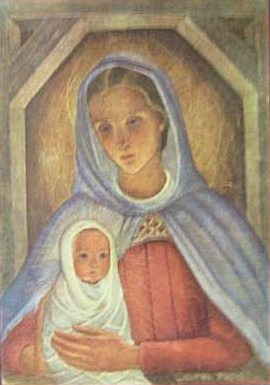
Madonna and Child
From the cover of Life magazine, December 25, 1944 - this was the only color cover of Life during World War II.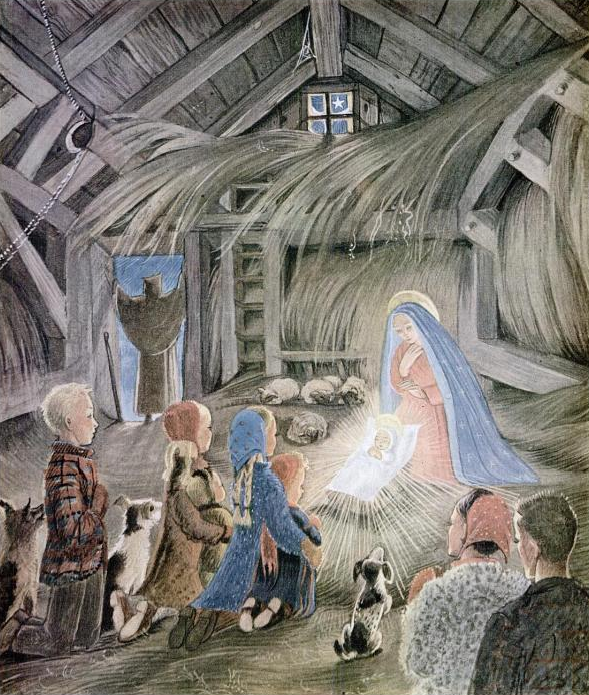
Adoration
Lauren Ford transplants the scene of the Nativity to a barn in Connecticut much like her own. Here she portrays her neighbors gazing in wonder at the Christ Child whose mother had "wrapped Him in swaddling clothes and laid Him in a manger; because there was no room for them in the inn," In the doorway stands St. Joseph awaiting the coming of the the Three Wise Men who are following the star of Bethlehem to where the Christ Child lies.
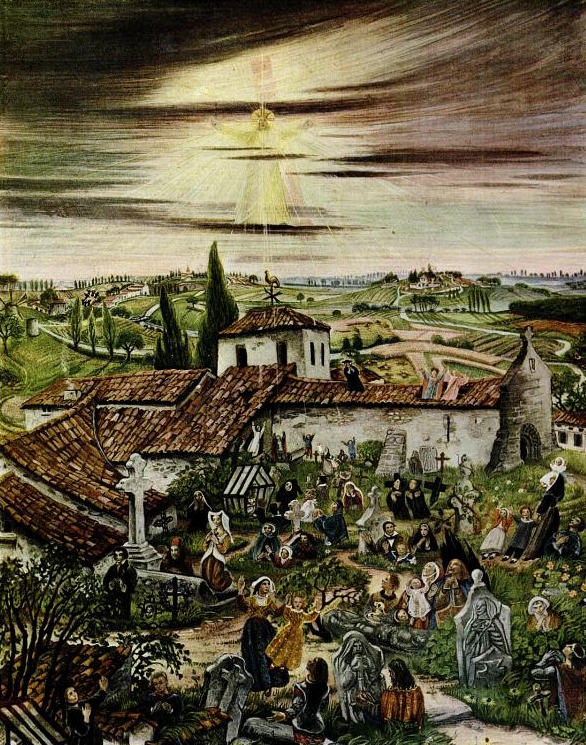
Resurrection
The day of the Last Judgement when "the dead, small and great" will stand before God is portrayed by Lauren Ford as taking place in the little churchyard of Montguyon in southwestern France. The graves open up and all hwo have been buried there emerge to be judged by Christ in the name of God. On horizon (left) is an old convent building, bought by Miss Ford and a friend and later turned into a refuge for children when Germans invaded France.
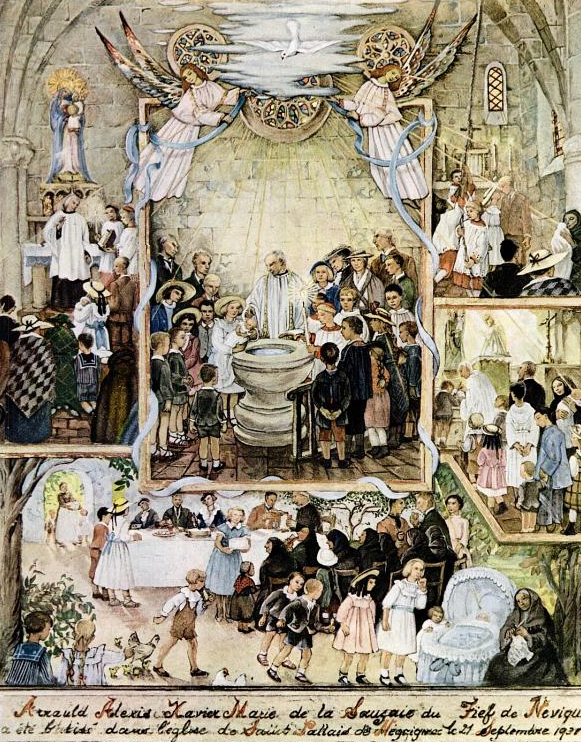
Baptism of Arnauld
While Lauren Ford was living in France, she painted as a momento the story of the baptismal rites of the child of the friends with whom she was staying. In the tradition of religious paintings of the Middle Ages, guardian angels and the dove representing the Holy Spirit hover over the baptismal scene. The baptism took place in the country church of St. Pallais de Negrignac, which Miss Ford has placed on the right horizon in the painting on the opposite page.
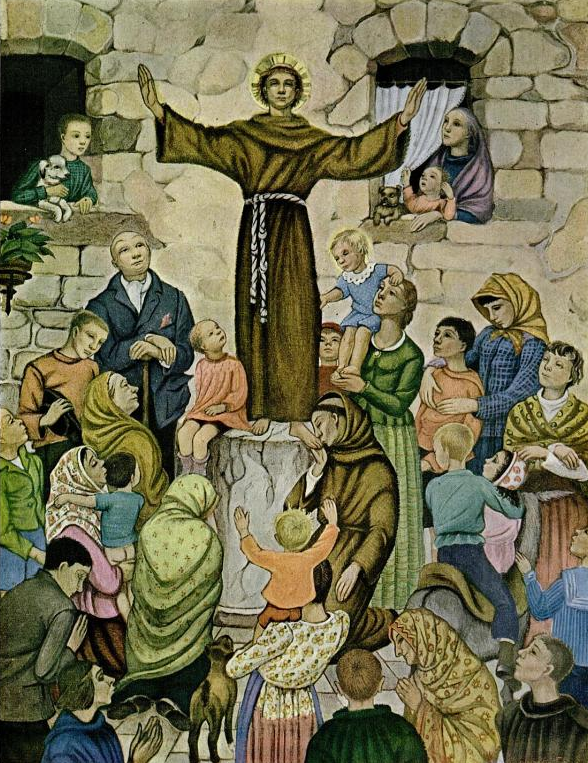
St. Francis
To paint this picture of Christ's devout disciple, Lauren Ford journeyed from France to the hilltown of Assisi in central Italy, the birthplace of St. Francis. There, on one of the little town's narrow cobblestone streets, against the background of ancient Italian architecture, Lauren Ford painted an imaginary scene symbolizing the founding of the Third Order of St. Francis, whose lay followers dedicated themselves to the teachings of humility.
St. Germaine
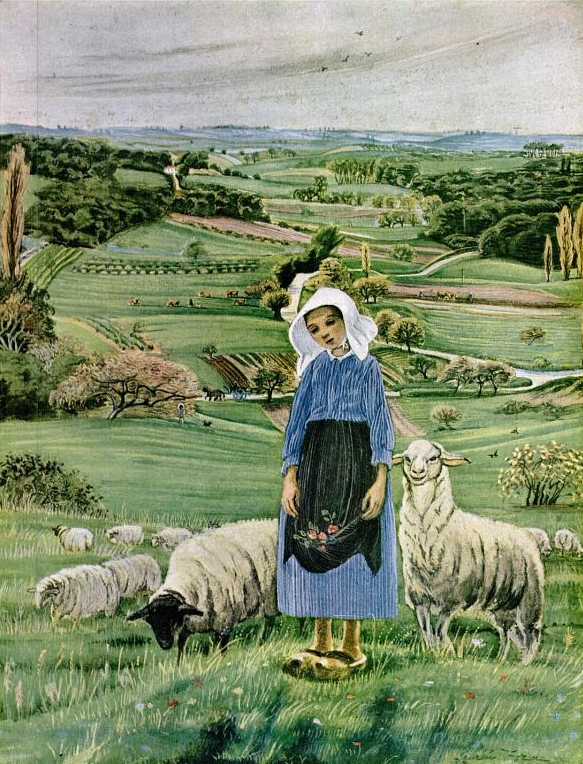
St. Germaine was the child of a poor farm laborer in southern France who, after her death in 1601, was canonized. Lauren Ford shows her as a shepherdess and tells the story of the day she was accused by neighbors, whose shadows are east in foreground, of stealing food for a starving stranger. At the demand that she show what she has hidden in her apron, Germaine miraculously revealed fresh roses though it was late autumn and roses were not in bloom.
The Celestial Mother
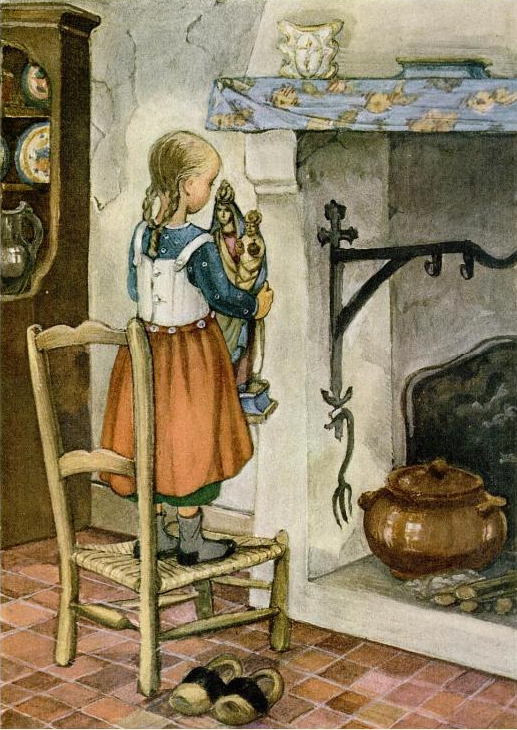
A scene in the childhood of Blessed Catherine Laboure was painted by Lauren Ford. Left motherless, Catherine climbed up on chair and, lifting the statue of the Virgin from the mantel, asked that the Virgin be her adopted mother. Later, as a nun, Catherine predicted France would go through a terrible stress. She died in 1876, leaving a diary which told of miraculous visions, and was beatified in 1933.
The First Communion Dress
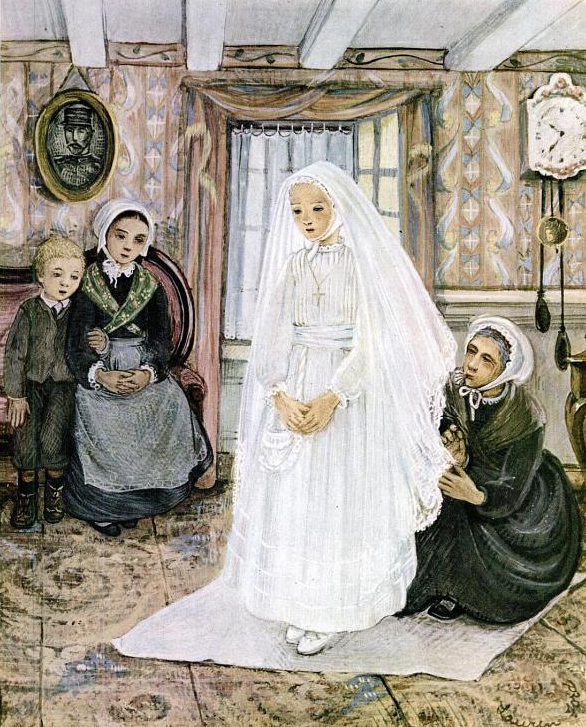
Catherine Laboure is being dressed for her First Communion in the home of her godmother, who is shown with her mouth full of pins, adjusting Catherine's long veil. Watching them in awed silence are Catherine's sister Tonine and brother Auguste. To protect the pristine whitness of the precious dress, which has been handed down from generation to generation, Catherine stands upon a spotless carpet specially spread for this momentous occasion.
Guardian Angel
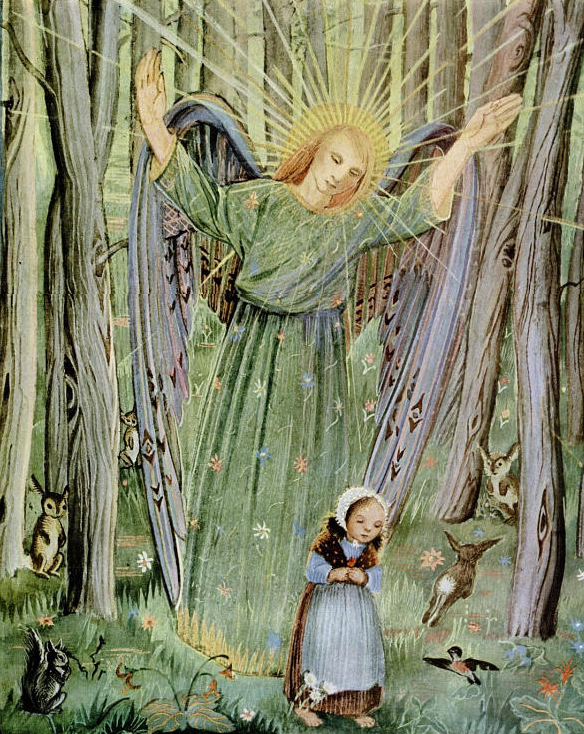
The child trudging through the woods protected only by her guardian angel is Melanie de La Salette, who lived 100 years ago in southeastern France. The fifth child of poor peasants, Melanie had an unnaturally brutal mother who sent her out to beg and often tried to lose her in the woods. But Melanie, watched over by her guardian angel, miraculously survived and later, when Melanie's mother grew old, the girl cared for her tenderly until her death.
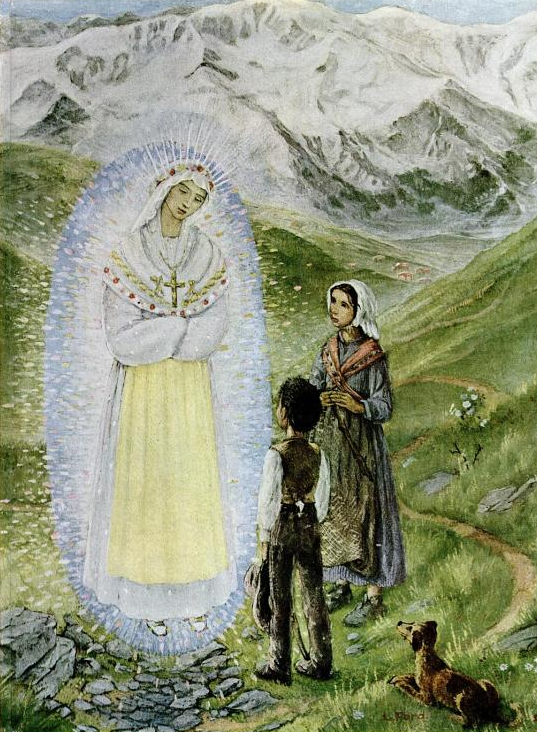
Vision of La Salette
When Melanie de La Salette was 14 the vision of the Virgin appeared to her and her little friend Maxim while they were wandering about in the fields. The Virgin stood before them wearing an apron "the color of light, her gown sewn with pearls that looked like tears." She spoke in perfect French which the children were able to repeat to their elders, though they ordinarily could speak only the dialect of the countryside.
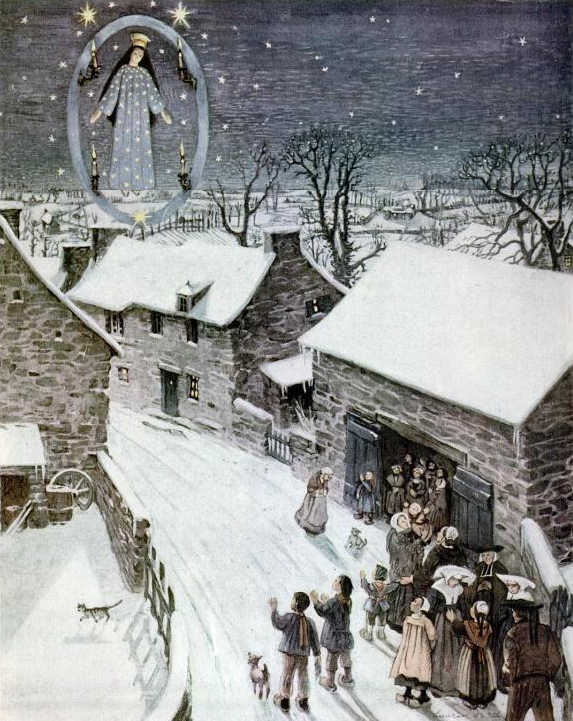
The Vision at Dusk
One evening in 1871 the villagers of Pontmain in Brittany were praying that they be saved from Prussian invaders who were one mile from the town. Suddenly six small children playing in the snow saw in the sky the Virgin appear surrounded by a halo of light. Attracted by the children's exclamations, the older people came running. Since they were grownups, they could see nothing. But within a half hour the Prussians were turned back.
From "A Portfolio of Religious Paintings by Lauren Ford," Life magazine, Dec 25, 1944.
Subscribe to:
Comments (Atom)